
From your Inner ear to your inferior vena cava. Learn about your anatomy with these body parts that start with I. This post is perfect for curious minds ready to learn and explore!
Body Parts That Start With I

Are you ready to learn more about your amazing body and some of the amazing parts that start with the letter I? Our bodies are the coolest machines with a ton of different parts each doing a different and special job. Today, we’ll jump into learning about some of the not-so-familiar body parts like the Illiac Spine which is a little bone on your pelvis or your intestines that help you digest your food, or the inferior Concha which helps to humidify and filter the air that we breath.
That’s not all! We will also be learning about the Iliofemoral Ligament which is the strongest ligament in our bodies, A tiny joint in our ear called the Incudomalleolar joint, and the inner thigh muscle which helps you walk. We will be learning all of these and more! There are so many amazing parts of our body. We are going to have such a great time getting to know all about them on our journey to learn all about how some work and why we have others. Let’s jump in and have fun learning all about them!
Let’s put back on our explorer hats, and get ready to learn about some more amazing facts about these I body parts.
Find What You are Looking For
- List of body parts that start with I
- Facts about Body Parts That start with I
- Common Body Parts that start with I

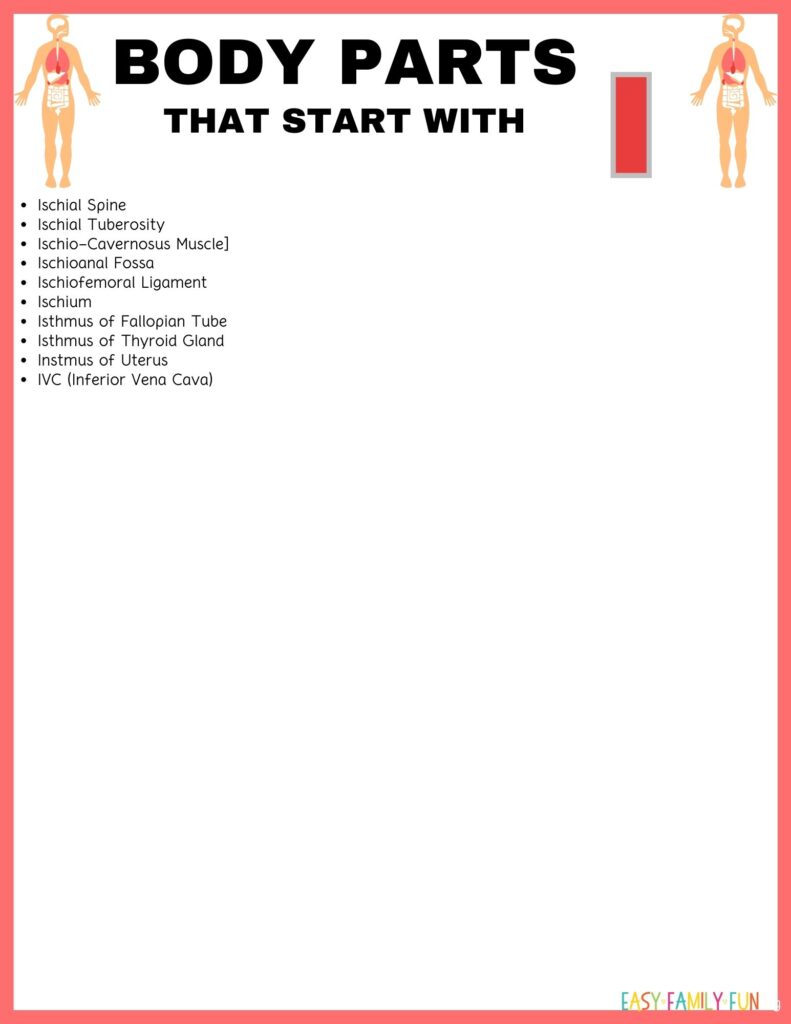
List of Body Parts That Start with I
- Iliac Vein
- Iliacus Muscle
- Iliofemoral Ligament
- Iliopsoas Muscle
- Iliotibial Band
- Iliotibial Tract
- Ilium
- Incisive Canal
- Incisive Fossa
- Incisive Papilla
- Incisor Teeth
- Incudomalleolar Joint
- Incus
- Inferior Alveolar Nerve
- Inferior Alveolar Nerve
- Inferior Cerebellar Arteries
- Inferior Colliculus
- Inferior Concha
- Inferior Epigastric Artery
- Inferior Epigastric Vein
- Inferior Extremity
- Inferior Gluteal Artery
- Inferior Gluteal Nerve
- Inferior Labial Artery
- Inferior Mesenteric Artery
- Inferior Mesenteric Vein
- Inferior Nasal Concha
- Inferior Oblique Muscle
- Inferior Ophthalmic Vein
- Inferior Orbital Fissure
- Inferior Pancreaticoduodenal Artery
- Inferior Phrenic Arteries
- Inferior Pubic Ramus
- Inferior Rectal Artery
- Inferior Rectal Nerve
- Inferior Rectal Vein
- Inferior Rectus Muscle
- Inferior Rectus Muscle
- Inferior Sagittal Sinus
- Inferior Tarsus
- Inferior Temporal Gyrus
- Inferior Thyroid Artery
- Inferior Turbinate
- Inferior Vena Cava
- Infraorbital Artery
- Infraorbital Foramen
- Infraorbital Nerve
- Infraorbital Vein
- Infundibulum
- Inguinal Canal
- Inguinal Ligament
- Inner Ear
- Inner Meniscus
- Inner Thigh Muscles
- Innermost Intercostal Muscle
- Innominate Artery
- Insula
- Inter-Atrial Septum
- Interatrial Septum
- Interatrial Wall
- Intercalated Discs
- Intercarpal Joints
- Intercellular Junctions
- Interchondral Joints
- Interclavicular Ligament
- Intercondylar Fossa
- Intercondylar Notch
- Intercostal Arteries
- Intercostal Muscles
- Intercostal Nerves
- Intercostal Spaces
- Intercostal Veins
- Interdental Papilla
- Interdigital Folds
- Interdigital Web
- Interior Cerebral Veins
- Intermediate Bronchus
- Intermediate Cuneiform
- Intermediate Dorsal Cutaneous Nerve
- Intermediate Tibiofibular Joint
- Internal Acoustic Meatus
- Internal Anal Sphincter
- Internal Auditory Canal
- Internal Carotid Artery
- Internal Carotid Artery
- Internal Cerebral Veins
- Internal Iliac Artery
- Internal Iliac Vein
- Internal Intercostal Muscles
- Internal Jugular Vein
- Internal Mammary Artery
- Internal Oblique Muscle
- Internal Pudendal Artery
- Internal Pudendal Vein
- Internal Thoracic Artery
- Internal Thoracic Vein
- Internasal Suture
- Interosseous Membrane
- Interparietal Bone
- Interphalangeal Joints
- Interpubic Disc
- Interstitial Cells
- Interstitial Fluid
- Interstitium
- Intertransversarii Muscles
- Interventricular Foramen
- Interventricular Septum
- Intervertebral
- Intervertebral Foramen
- Intestinal Villi
- Intestines
- Intracranial Part of Optic Nerve
- Intraembryonic Coelom
- Intrafusal Fibers
- Intramuscular Fat
- Intraparietal Sulcus
- Interspinous Ligament
- Intraventricular Septum
- Intrinsic Hand Muscles
- Intrinsic Laryngeal Muscles
- Intrinsic Muscles of Tongue
- Iris
- Ischial Spine
- Ischial Tuberosity
- Ischio-Cavernosus Muscle
- Ischioanal Fossa
- Ischiofemoral Ligament
- Ischium
- Isthmus of Fallopian Tube
- Isthmus of Thyroid Gland
- Isthmus of Uterus
- IVC (Inferior Vena Cava)

Facts About Body Parts That Start With I
What are Intercostal Nerves?
The Intercostal Nerves help muscles to contract and aids in the return of sensory information from the skin.
What do the Intestinal Villi do?
Intestinal Villi are little, finger-like projections that are made of cells that line your small intestine. The villi absorb nutrients from the food you eat and send them into your bloodstream to go where they need to go.
What does the Insula do?
The insula is a part of the brain that is linked with self-awareness, interoception, pain processing salience detection, and addiction.
What is the Inferior tarsus?
It is a muscle that helps the lower eyelid retract and helps supply the sympathetic nerves.
What do Interspinous ligaments do?
Interspinous ligaments are thing ligaments that connect parts of the vertebra.
What is the Iris?
The Iris is the colored part of your eye. It helps to regulate how much light enters the eye.
What does the Internal Jugular vein do?
It collects blood from the brain and parts of the face and neck. It then takes it to the right atrium.
What does the Intermediate Tibiofibular joint do?
This joint helps to connect the tibia and fibula bones in our legs.
What are Intercalated discs?
They are little parts of the heart muscle cell that helps block the internal and external components of the cell.
What do the intraparietal sulcus do?
They help with planning eye movements, grasping movements, reaching and defensive forelimbs, and head movements.
What is the Iliofemoral Ligament?
It is the strongest ligament in the body. It helps to prevent your femur from extending too much.
What is the Intercondylar fossa?
It is a small groove on the femur. It is home to important stabilizing structures and ligaments.
What does the Incus do?
The Incus helps transmit the sound that we hear to the inner ear.
What does the Inferior concha do?
It is a little bone that sits at the lateral wall of the nasal cavity. The concha helps filter and humidify the air that we breathe.
What does the Auditory canal do?
The auditory canal helps make the sound we hear louder.
What does the Inferior sagittal sinus do?
It collects blood from the falx and medial surfaces of the brain hemispheres.
What does the Inferior temporal gyrus do?
It helps the processes of visual information.
What are the Intercostal muscles?
The intercostal muscles are several different groups of muscles that go in between the ribs adn help to move and form the chest wall.
What does the Inferior oblique muscle do?
It helps rotate, elevates, and abducts the eye.
What are the Intrinsic hand muscles?
There are four muscle groups located at the base of the thumb and help to make the thumb move.
The Most Common Body Parts That Begin With I
- Iris
- Inner Ear
- Intestines
The human body is truly a wonder! As you delve into its mysteries, I hope you are amazed at how intricate and beautifully designed it is. Just think about how amazing each part of your ear is or the strength of the ligaments in your legs. Each part, big or small, is a testament to the incredible engineering of nature. Here’s to celebrating and appreciating the amazing human body in all its complexity!